
Running a medical practice in Australia brings unique financial pressures. Doctors earn high incomes but often feel like money disappears faster than it should.
Complex expenses, heavy tax bills, and strict compliance rules leave many wondering where their hard work has gone.
Unlike other professions, medical professionals juggle multiple income sources, demanding schedules, and financial obligations that rarely fit a simple template.
It’s no surprise that even experienced practitioners can feel overwhelmed and uncertain about whether their accounting is working in their favour.
This guide is designed specifically for Australian medical practices. It highlights why accounting is mission-critical, outlines the biggest challenges doctors face, and shows how the right systems create clarity and confidence.
If you’ve ever felt the weight of tax stress or struggled to keep financial order, you’re in the right place.
Why Medical Practices Need Specialist Accounting
Specialist accounting for medical practices in Australia is essential because doctors face unique financial pressures. Without tailored systems, many overpay tax or miss legitimate deductions.
Key challenges that make specialist support vital include:
- High tax bills: Doctors quickly reach the top marginal tax rate, and without planning, a large share of income is lost.
- Multiple revenue streams: Income can come from hospital contracts, private billing, locum work, Medicare rebates, and insurance claims, each with different reporting obligations.
- Complex expenses and structures: Practices must manage wages, equipment, memberships, and facility costs while navigating companies, trusts, or partnerships.
- Frequent career transitions: Doctors move from training to registrar roles, into private practice, or combine public and private work, each shift requiring different accounting strategies.
- Cash flow volatility: Locum work and delayed Medicare payments can create uneven income, making budgeting and forecasting difficult.
- Regulatory compliance: Medical practices must meet strict reporting, payroll, and superannuation obligations, with penalties for errors or late lodgements.
Wealthmed helps doctors address these challenges by strengthening accounting compliance for clinics and building strategies that protect income while supporting growth.stones, see financial planning for doctors in 2025.
Tax Obligations for Medical Practices
Tax is one of the biggest financial burdens for medical professionals, and accounting for medical practices in Australia requires clear strategies to manage it effectively. Doctors are high earners, and income tax rates climb quickly into the top bracket.
Without planning, large amounts of income disappear into taxes rather than being directed toward wealth creation.
The main areas that demand close attention are:
- Income tax rates for high earners: Most doctors move into the highest tax bracket early in their careers. Once there, the tax bill becomes the largest ongoing cost, requiring proactive management to prevent overpayment.
- PAYG instalments and bracket creep: When income rises, the ATO often requires quarterly Pay As You Go instalments. Doctors also face bracket creep, where more of their income is taxed at higher rates each year.
- GST for medical practices: Many medical services are GST-free, but not all. Cosmetic procedures, some allied health services, and products sold through clinics can attract GST, creating confusion without proper accounting compliance for clinics.
- Superannuation obligations for staff: Practices employing nurses, receptionists, or allied health professionals must make timely super contributions. Late or missing payments attract penalties and reduce trust within the practice.
- Fringe Benefits Tax (FBT): Cars, entertainment, and other non-cash benefits offered to staff or practitioners may be subject to FBT. Poor structuring here can create unexpected tax bills that undermine cash flow.
Business Structures for Medical Practices in Australia
The way a medical practice is structured has a direct impact on accounting outcomes in Australia. Liability, tax efficiency, cash flow, and even succession planning are all shaped by this choice.
For doctors, choosing the right framework early can be the difference between building sustainable wealth and facing unnecessary risks.
Many junior doctors begin their careers as sole traders because the structure is simple to establish and easy to manage.
While this suits the early stages of practice, it leaves the individual personally liable for debts and offers limited scope for tax planning. As incomes rise and expenses grow, remaining a sole trader often becomes restrictive.

Some practitioners, particularly those working together in general practice, form partnerships to share costs and income. This can reduce overheads and create efficiency in running a clinic, but it also exposes each partner to the liabilities of the other.
For busy doctors, that exposure can create financial risks that outweigh the benefits of simplicity.
High-earning specialists often turn to companies as their preferred structure. Operating through a company creates stronger asset protection and provides opportunities to retain profits for reinvestment rather than paying them out immediately as personal income. This can ease the pressure of high tax rates and improve long-term financial stability.
Trusts provide another strategic option, particularly when doctors are focused on succession planning or want flexibility in distributing income to family members.
While trusts can support intergenerational wealth transfer and tax efficiency, they demand strict compliance and ongoing management to remain effective.
Consider the difference between the two scenarios. A GP partnership might run smoothly when sharing premises and staff, but each partner remains exposed to the other’s obligations.
A specialist with significant personal income, by contrast, may choose a company structure that delivers stronger protection and more effective tax outcomes.
Wealthmed works with doctors to ensure that structures evolve alongside career stages, income growth, and personal goals.
With the right setup, medical practice accounting becomes not only more efficient but also more resilient, paving the way for better risk management and long-term wealth.
Expense Management and Deductions
Expense management is a critical part of accounting for medical practices in Australia. The right approach ensures compliance and maximises the benefits of medical practice tax deductions. Without structure, doctors often miss opportunities to reduce their taxable income.
Common deductions for doctors include:
• Continuing professional development (CPD) courses and medical conferences
• Membership fees for professional associations
• Travel costs related to patient care or specialist training
• Medical equipment purchases and technology tools
• Protective clothing and uniforms used in clinical settings
A second layer of tax planning involves distinguishing between capital and operating expenses. Large purchases such as diagnostic machines or clinical fit-outs are capital expenses, meaning they are depreciated over several years rather than deducted in full upfront.
Many doctors overlook these rules, missing out on valuable depreciation schedules that can improve tax efficiency.
A structured checklist of deductible items should include:
• CPD programs and other professional training
• Professional memberships and registrations
• Uniforms, protective gear, and medical tools
• Equipment, technology, and practice fit-outs (with depreciation applied where required)
• Travel and accommodation costs linked to clinical or educational duties
• Consumables and supplies directly tied to patient care
Revenue and Billing Management
Revenue is the foundation of every clinic, and billing management plays a critical role in accounting for medical practices in Australia.
With multiple payment streams in play, doctors need structured processes to ensure income is collected on time and accurately recorded.
Without strong systems, practices risk losing revenue through delays, underpayments, or denied claims. The most important elements to manage effectively are:
Billing Models
Clinics often combine bulk billing, private billing, Medicare claims, and insurance reimbursements.
Bulk billing offers predictable cash flow but slimmer margins, while private billing improves profitability but requires diligent receivable management. Medicare and insurance claims can add delays, making it vital to track payments closely.
Revenue Recognition Best Practices
Income must be recorded in the correct period and matched against services provided. This ensures financial reporting remains accurate, particularly in clinics with multiple practitioners or mixed billing models.
Receivable Management
Denied or late claims can quickly disrupt cash flow. Proactive monitoring, prompt follow-ups, and resolving discrepancies early prevent small issues from turning into significant revenue losses.
Technology Integration
Linking billing platforms with accounting software for doctors reduces manual effort and errors. Integrated systems automate reconciliations, streamline reporting, and provide real-time visibility into financial performance.
Cash Flow, Budgeting, and Forecasting
Cash flow is king for medical practices because income only supports a clinic when it is available to cover daily costs.
A practice may look profitable on paper, yet if Medicare or insurance payments are delayed, bills still fall due.
Strong cash flow management ensures stability and provides the confidence to plan for future growth.
Budgeting gives that cash flow direction. By planning for salaries, superannuation, and overtime, practices can anticipate the largest ongoing expense—staffing.
From there, the budget extends to consumables such as medical supplies and protective equipment, and finally to scheduled upgrades of clinical equipment and technology, which safeguard both compliance and competitiveness.
Forecasting builds on the budget by preparing for scenarios that can disrupt financial balance. Unplanned expenses such as equipment breakdowns or regulatory requirements can appear suddenly, while staff resignations or recruitment delays create added strain.
Medicare and insurance payment lags compound the problem, highlighting why scenario planning is essential.
A locum doctor illustrates this clearly. Income may surge in busy months only to drop sharply when work slows, leaving the practice vulnerable if spending has not been managed carefully.
With structured forecasting and well-designed budget templates, peaks in income can be allocated to cover leaner months so that rent, payroll, and loan repayments are never compromised.
Wealthmed helps medical professionals design systems that link budgeting, forecasting, and cash flow into a seamless process. This integration allows risks to be identified early and ensures that income variations do not derail long-term plans.
With these tools in place, clinics can protect themselves against uncertainty and move forward with clarity and control.
Accounting Software for Medical Practices
Selecting the right accounting software is essential for medical practices in Australia. The right system reduces administrative pressure, ensures accounting compliance for clinics, and provides reliable data for decision-making.
Without strong technology, practices risk errors, inefficiency, and missed opportunities for automation.
General accounting platforms remain popular across healthcare settings:
- Xero offers cloud-based access, smooth bank integration, and automated reconciliation.
- MYOB provides robust payroll tools and is well-suited to compliance reporting.
- QuickBooks delivers an affordable, user-friendly option for small to mid-sized practices.
Healthcare-specific software can add another layer of functionality:
- Genie integrates patient management, Medicare billing, and financial workflows.
- Best Practice combines scheduling, clinical records, and claims processing in one system.
- Cliniko offers cloud-based patient records, appointment booking, and invoicing.
When choosing accounting software for doctors, the most important features are integration with billing systems, compliance reporting for BAS and superannuation, and automation that reduces manual duplication.
Cloud access for both accountants and practice managers creates real-time visibility and safeguards financial data.
In-House vs Outsourced Accounting
Medical practices must decide whether to manage their accounting in-house or outsource it to specialists.
Each approach has strengths and weaknesses, and the right choice depends on practice size, income complexity, and the need for specialist advice.
In-house bookkeeping provides direct control over payroll, invoicing, and reconciliations, but it comes with higher staff costs and the risk of limited expertise.
Outsourcing to healthcare accounting specialists often delivers greater efficiency, proactive tax planning, and compliance tailored to medical practices.
Comparison of In-House vs Outsourced Accounting
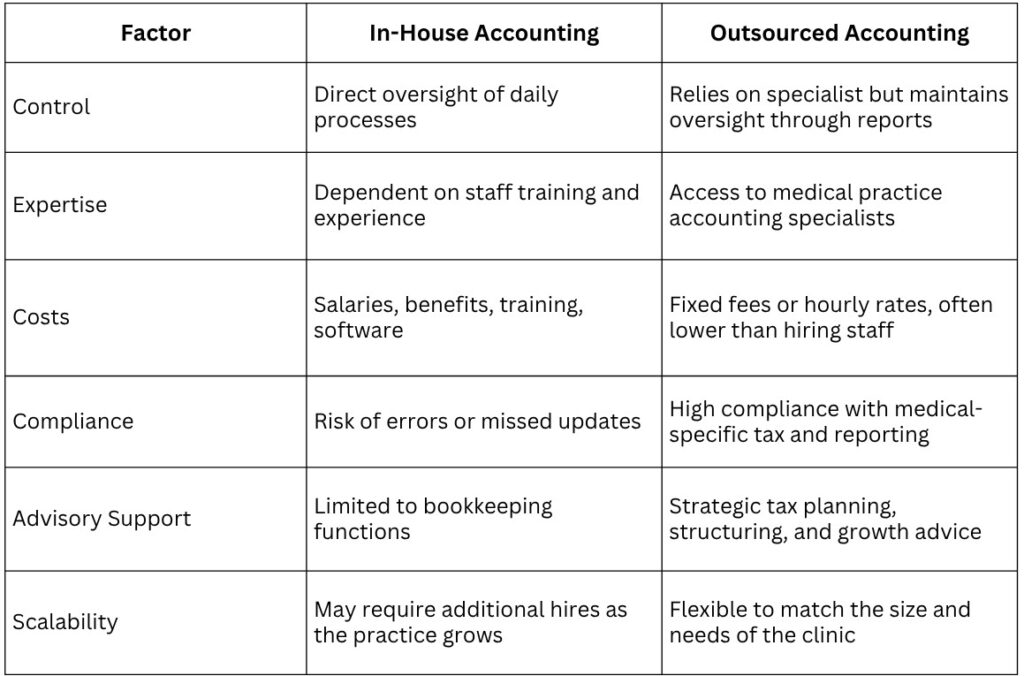
Return on investment often favours outsourcing. Hiring in-house staff increases ongoing payroll costs, while outsourcing provides specialist advice at a lower total expense. The result is fewer errors, improved compliance, and stronger financial outcomes.
When choosing a healthcare accountant, practices should look for experience with Medicare and private billing systems, knowledge of GST for medical practices, and the ability to deliver proactive strategies that go beyond bookkeeping.
Secure cloud-based access and automation are also key indicators of a strong accounting partner.
Risk Management and Compliance
Risk management and compliance are central to accounting for medical practices in Australia. A well-designed framework protects clinics from financial setbacks, keeps them aligned with regulatory standards, and builds confidence with patients and stakeholders.
The following areas highlight where practices must stay vigilant.
Financial Risks
Clinics can face losses through billing errors, exposure during audits, or internal fraud if proper systems are not in place.
Small mistakes left unchecked often escalate into compliance issues that affect both cash flow and reputation. Early identification and correction of risks safeguards the financial health of the practice.
Insurance Obligations
Insurance provides a vital safety net for practices. Professional indemnity cover is mandatory for doctors, while business insurance protects clinics against risks to staff, premises, and equipment.
Without these policies, practices remain vulnerable to unexpected events that can cause significant financial damage.
Internal Controls
Robust internal controls reduce the likelihood of errors and fraud in medical practice accounting. Segregating duties between staff, maintaining clear oversight of payments, and reconciling accounts regularly create stronger compliance. These measures give practice owners confidence in the accuracy of their financial reporting.
Data Security
Protecting sensitive patient billing information is both a compliance requirement and a trust issue.
Practices must store records securely, apply privacy safeguards, and ensure technology systems prevent unauthorised access. Strong data security practices maintain compliance while preserving patient confidence.
Take Control of Your Finances Today
Accounting done well is the difference between a practice that struggles and one that prospers. Doctors who treat their finances with the same discipline as their medical work gain control, protect compliance, and build lasting wealth.
The tools are here now. Automation and AI are already cutting through admin, tightening accuracy, and giving practices a clearer financial picture. Clinics that act quickly are positioned to grow, while those that delay keep falling behind.
Wealthmed is ready to help doctors move forward with confidence. Book your call with our specialist team today and secure the cash flow, compliance, and financial future your career has earned.
Disclaimer: The information contained in this blog/newsletter is general in nature and has been prepared without taking into account your personal objectives, financial situation or needs.Wealthmed’s financial planning services are provided by Eureka Financial Group Pty Ltd as an authorised representative of Fortnum Advice Pty Ltd (ABN 52 634 060 709; AFSL 519 190).Lending and mortgage‑broking services are provided by Yarra Lane Finance Pty Ltd under its Australian Credit Licence 392272 through Wealthmed credit representatives; these services are not provided under Fortnum’s AFSL.Accounting and tax services are delivered by Wealthmed Accounting Pty Ltd (Tax Agent No 24677924) as a separate entity and are not financial services under the AFSL.Nothing in this publication constitutes financial, legal or tax advice. You should seek professional advice relevant to your individual circumstances before making any financial decisions.