
An income protection waiting period is the time before your benefit payments start. It generally runs from when illness or injury stops you working. During that time, you usually cover your costs from other sources.
Income protection can replace part of your pre-tax income during a claim. It commonly covers a percentage such as 75% or 90%.
Three lengths come up often for doctors: 30, 60, and 90 days. There isn’t one option that suits every doctor. Your leave, savings, and cash flow all feed into it.
The right length often comes down to one question. How long could you manage without your usual income? Your answer can point towards a shorter or longer waiting period.
What Is an Income Protection Waiting Period?
Before any benefit is paid, a waiting period applies. You need to remain unable to work when it ends to qualify.
It’s sometimes called an elimination period or a deferred period. The names differ, though the idea stays the same. You choose the length when you arrange the policy.
Policies in Australia commonly offer waiting periods between 14 days and two years. The 30, 60, and 90 day options sit near the shorter end. Each shifts how much of the early period you fund yourself.
When does the waiting period begin?
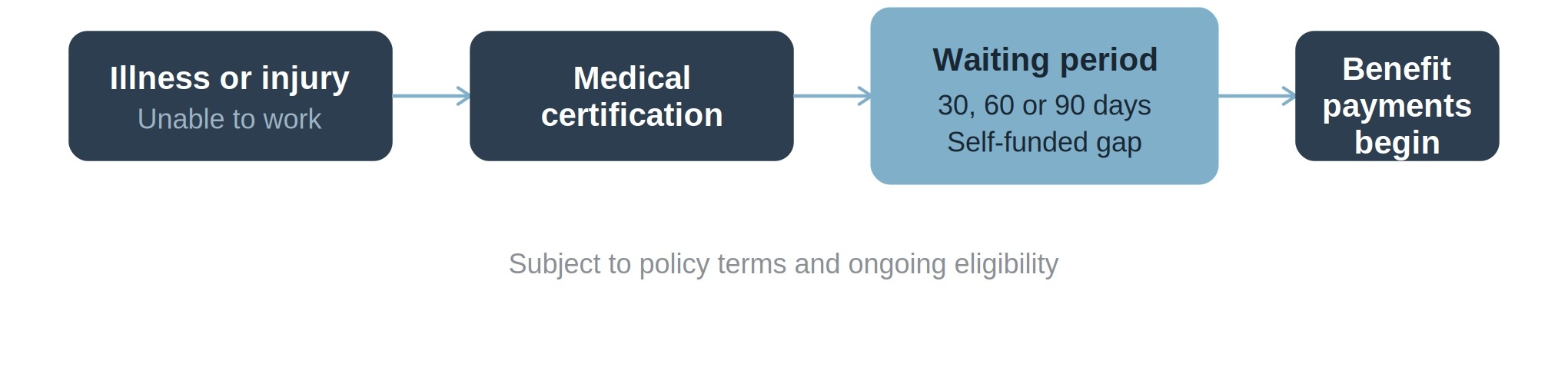
The waiting period starts once you’re unable to work, as your policy defines. Medical certification is part of the claim process. From that point, the clock on your chosen waiting period runs.
Payments don’t start on the first day of the waiting period. They generally begin once it ends, and only where the claim remains eligible and the policy criteria continue to be met. Policy provisions differ between insurers, so your Product Disclosure Statement (PDS) sets out how your own policy defines this.
Why do insurers include waiting periods?
Waiting periods help keep cover workable and premiums manageable. Short absences fall to your sick leave or savings instead. This keeps the cover focused on longer periods away from work.
Insurers price cover with the waiting period in mind. Extending the wait shifts more of the early cost to you. APRA, the prudential regulator, oversees the sustainability of income protection offered by Australian life insurers.
Claim timeline
Should You Choose a 30-, 60-, or 90-Day Waiting Period?
Each length changes when payments begin and how much you carry early on. A shorter wait may allow benefits to commence sooner if a valid claim is accepted, but premiums may be higher, and cover remains subject to policy terms and eligibility requirements. Choose a longer one and the premium can drop, though you self-fund for longer.
The table below sets out where each option can fit. Treat it as a starting point, not a recommendation. Your own circumstances guide the choice.
| Waiting period | May suit | Key consideration |
|---|---|---|
| 30 days | Limited paid leave or emergency savings | Payments may begin sooner, though the premium may be higher |
| 60 days | Moderate leave balances or savings | Balances the wait against the premium cost |
| 90 days | Longer paid leave or a larger emergency fund | Longer self-funded period, with potential premium savings |
The right fit is personal. Aim for a waiting period you could comfortably bridge with your leave and savings.
What Should Doctors Consider Before Choosing a Waiting Period?
A few practical factors can narrow the choice. Each points to how long you could manage without pay. Working through them can make the trade-offs clearer.
Your paid sick leave
Paid sick leave can cover part or all of a shorter waiting period. Salaried hospital doctors often have set leave entitlements. Locum and self-employed doctors may have little or none.
Check your current balance, not only your entitlement. A recent illness may have reduced it. The leave you actually hold shapes how long you could self-fund.
Your emergency savings
Savings can bridge the waiting period before benefits start. A larger buffer can support a longer wait, which may lower the premium. Less put aside may point to a shorter wait.
Be realistic about what you could access quickly. Funds locked in super or fixed terms may not help in the short term. Ready savings and offset balances tend to be more useful here.
Your employment type
Employment type affects the leave and benefits behind you. Salaried roles often include paid sick leave. Self-employed and locum doctors usually carry that risk themselves.
If your income stops when you stop working, it may be important to carefully assess whether you could meet expenses during a longer waiting period. Where more leave and savings sit behind you, a longer waiting period may be easier to self-fund. Your safety net can guide the sensible length.
Regular or variable income
Regular salaried income is easier to plan around. Variable income from locum or private work can rise and fall. That variability can make a longer self-funded wait harder to manage.
Benefits are generally based on your recent earnings. Variable earners may want to understand how a policy calculates this. The PDS and an adviser can help clarify it.
Your medical career stage
Your stage shapes your leave and savings, along with your wider commitments. An intern’s position may look different from a consultant’s. The waiting period that fits can shift over time.
The gap you would need to cover looks different at each stage. Base the choice on today’s leave and savings, not where you expect to be.
How Does Your Waiting Period Affect Your Premiums?
A longer wait means you cover more of the early period yourself before payments can start. In general, taking on more of that early period can come with a lower premium, though how much, if at all, varies by insurer and policy. Your Product Disclosure Statement (PDS) shows how your premium is calculated, and an adviser or your insurer can compare the premium at different waiting periods.
A shorter wait does the reverse. Payments can start sooner, though the premium may be higher. The difference in cost depends on your policy and personal factors.
Premium type also matters. Some premiums are age-stepped, recalculating as you get older. Others start higher, then rise more slowly. Each can suit different budgets and stages.
Premiums are one factor, not the whole picture. A lower premium from a longer wait can help cash flow today. It also leaves more of the initial gap for you to fund. Weigh both sides against your savings and leave.
Difference Between a Waiting Period and a Benefit Period
These two terms are easy to mix up. The waiting period is how long before payments start. The benefit period is how long payments can continue.
Both are chosen when you arrange cover. Together they shape the cost and the protection. The comparison below makes the contrast clear.
| Waiting period | Benefit period |
|---|---|
| Time before benefits may begin | Maximum length of benefit payments |
| Selected when taking out a policy | Also selected when arranging cover |
Benefit periods commonly run for two or five years. Some can run up to a set age, such as 65. A longer benefit period can support recovery from serious events, though it can raise the premium.
How Does Your Waiting Period Fit Into Your Overall Financial Plan?
A waiting period rarely stands alone. Beyond your savings and leave, it touches your household budget, tax, and super. Seeing those links can lead to a steadier choice.
Household cash flow. A partner’s income can ease pressure during a claim. On a single income, payments sooner may matter more.
Tax considerations. Premiums for personally held income protection can be tax-deductible. Benefit payments are ordinarily treated as assessable income.
Superannuation. Cover inside super has premiums drawn from your balance, which can reduce retirement savings. Premiums paid this way are generally not deductible to you personally.
Long-term planning. Your needs shift as debts and income move. Revisiting cover over time can keep it current.
Insurance sits within a wider strategy, alongside your tax position, super, and savings. Reviewing these together can help them pull in the same direction.
Waiting Period Considerations for Different Types of Doctors
Different roles carry different leave, income, and commitments. The length that suits can vary from one doctor to the next. These are general observations, not firm rules.
Junior doctors
Early on, a smaller savings buffer can make a shorter waiting period feel more manageable. Paid sick leave may also cover part of that gap.
As financial resilience builds, you may feel more at ease with a longer wait. Reviewing cover as income rises can help it keep pace with your situation.
Registrars
Registrars are likely to change hospitals during training. Income often grows across these years. Both factors can affect the wait that suits.
A moderate waiting period can balance cost and cover. You can adjust it at each move as earnings rise.
Consultants
By the consultant stage, financial commitments are often larger. A mortgage or practice costs can feature, along with family needs.
Cover set up earlier may no longer fit. Checking the waiting period against current savings and leave can help.
Doctors in private practice or locum work
For this group, cash flow planning is often central. Income can move from month to month, and employer leave is often limited.
Where little paid leave sits behind you, the financial impact of a longer waiting period may be more significant. Doctors with stronger savings may have greater flexibility when weighing different waiting period options. The suitable length depends on your buffer and income pattern.
Questions to Ask Before Choosing Your Waiting Period
A short checklist can bring the decision into focus. Work through each question with your own numbers. Your answers can guide you to a suitable length.
- How long could I cover my expenses without working?
- How much paid sick leave do I currently hold?
- Would my household have another income source during a claim?
- Has my employment or income pattern changed recently?
- Could my emergency savings stretch across several months?
- Does this waiting period fit my broader financial plan?
Myth vs Fact: Waiting Periods
A few common assumptions can cloud the choice. Clearing them up can make the comparison easier.
| Myth | Fact |
|---|---|
| A shorter waiting period is the smarter option for everyone | The right length depends on your leave and savings buffer |
| Payments start as soon as you stop work | Payments generally begin after the waiting period ends |
| A longer waiting period only works against you | Choosing a longer wait can trim the premium, in return for covering more of the gap yourself |
Frequently Asked Questions
Is a 30-day or 90-day waiting period better?
Neither suits every doctor. A 30-day wait can start benefits sooner, often at a higher premium. Stretching to 90 days can lower the cost, if your savings and leave can bridge the gap.
Can I change my waiting period later?
Often you can apply to change it. A change usually means varying your policy, which may involve reassessment. The insurer’s terms and your health can affect the outcome.
Does annual leave count during the waiting period?
It depends on your policy wording. Some policies treat certain leave in specific ways during the waiting period. Your PDS sets out how leave and the waiting period interact.
What happens if I return to work before my waiting period ends?
Some policies allow a short return without restarting the wait. Others may treat it differently. The PDS explains how your policy handles a brief return.
Does income protection through super have different waiting periods?
Cover in super, sometimes called salary continuance, also has a waiting period. The fund sets the default terms, and the benefit period may be shorter than cover outside super. Super cover can also stop if the account becomes inactive.
Does the waiting period affect how long benefits are paid?
These are separate settings. The waiting period sets when payments start. The benefit period sets how long they continue.
Can locum doctors choose different waiting periods?
Locum doctors can generally choose from the same options. Where employer leave is limited, the financial impact of a longer waiting period may be more significant. Doctors with larger cash reserves may have greater flexibility when considering different waiting period options.
Does my waiting period affect my premium?
It can. In general, a longer wait comes with a lower premium, because you cover more of the opening weeks yourself, though the amount varies by insurer and policy. Your PDS sets out how your premium is worked out, and an adviser or your insurer can compare different waiting periods.
Need Help Reviewing Your Income Protection?
Three points can guide the decision.
- The waiting period that fits depends on your circumstances and how you’re employed.
- Premiums are one part of the decision; weigh them against your savings and leave.
- A waiting period fits better when reviewed alongside your broader financial strategy.
Viewed together, these points reinforce each other. A calm review can help you settle on a length you could sustain.
If you’re unsure whether your current waiting period still suits your circumstances, we’re happy to help you understand how it fits within your broader financial plan. Book a quick chat here.
Disclaimer: The information contained in this blog is general in nature and has been prepared without taking into account your personal objectives, financial situation or needs.
Wealthmed’s financial planning services are provided by Eureka Financial Group Pty Ltd as an authorised representative of Fortnum Advice Pty Ltd (ABN 52 634 060 709; AFSL 519 190). Lending and mortgage-broking services are provided by Wealthmed as a credit representative of Yarra Lane Finance Pty Ltd (Australian Credit Licence 392272).
Accounting and tax services are delivered by Wealthmed Accounting Pty Ltd (Tax Agent No 24677924) as a separate entity and are not financial services under the AFSL.